


B2R matchmaking and networking events offer institutions a valuable framework to support researchers’ career exploration beyond academia. They create structured spaces for dialogue between researchers and the private sector, highlight the added value of research competences, and help strengthen connections with the broader business and innovation ecosystem. In some cases, these events also contribute directly to recruitment and support career diversification.
Imagine this: you want to organise a networking opportunity for researchers and research companies in your country or even beyond your borders. How do you organise an event like this?
To help you, the R2B matchmaking event toolkit was created. It offers you guidance in the different types of event and the steps necessary to organise them. To decide if you want to organise or simply join an event, take a look at the following questions:
- Do you have an extensive contact database?
- Do you have experience with organising events?
- How much time can you spend on the event?
- How much manpower do you have available for support?
- What is the budget available?
If you have little experience, or your resources (time, budget and contacts) are minimal, it might be a good start to join an existing event. You can benefit from the contact database of the organisers and you don’t have to spend a lot of time or budget.
If you have some experience with organising an event, and you have more time and budget, you can take a next step, and organise a subevent within a bigger event. In this set-up, you can still benefit from the experience and contact database of the main organiser. However, you have more control over the programme and possible impact.
If you are a pro, with a support team and a decent budget, then you can organise your own event. Via the tabs below, you can find steps and tips to follow for each type of event.
-
If you have (some) experience with organising events, and you have sufficient time, budget and contacts, then organising your own event might be beneficial. You can create your event exactly the way you envisioned and are in full control of the outcomes.
Before you start drafting the programme and outlining the agenda though, it is useful to take a step back and reflect on a few key questions. Discussing these early on will help you clarify the aims, scope, and overall direction of your event.
Design Phase
When planning a networking or collaboration event, several strategic choices will shape its relevance, reach, and overall impact. Decisions about thematic focus, geographic scope, partnerships, and interaction formats all influence who participates and how meaningful the connections will be. The following guiding questions are designed to help you define a coherent approach, balance ambition with feasibility, and design an event that aligns with your objectives and target audiences.
Defining a clear thematic focus is essential for developing a relevant event agenda and ensuring effective communication. This can be achieved in different ways, for example by aligning the event with a broad theme such as health, climate change or artificial intelligence, or by focusing on a specific discipline such as the life sciences.
A more specific thematic focus increases the likelihood that participants will find relevant and meaningful connections. It also makes communication easier and helps manage expectations, as potential participants will have a clear understanding of what the event offers.
At the same time, a narrower focus can make recruitment more challenging. Unless your institution has a strong thematic profile or you are in a region with a high concentration of employers in a particular sector, attracting a sufficient number of participants and companies may require extra effort.
A more general approach can therefore be a good starting point, especially if you are organising a networking event for the first time. It usually makes participant recruitment easier and allows you to build your network.
Organising a cross-border event comes with certain challenges. You may lose the advantage of using the local language and established local networks, and some companies may be more motivated to participate in initiatives that directly benefit their local or regional ecosystem.
On the other hand, a cross-border approach can significantly broaden the pool of participants and opportunities. It also allows you, as an organiser, to expand your own collaboration networks and strengthen international partnerships.
Cross-border cooperation can take different forms. You might organise onsite events together with partners in neighbouring regions, or — in the case of an online event — open participation to researchers and employers from across Europe and beyond.
Partnering with other organisations can help distribute the workload and strengthen the event’s reach and impact.
Consider involving:
- Other units within your institution, such as technology transfer offices or career development centres
- EURAXESS colleagues in your country or region; for cross-border events, EURAXESS partners in other countries are natural collaborators
- Enterprise Europe Network, which has strong links to local business ecosystems
- EURES (the European Employment Service) and EUROGUIDANCE (the European network for career guidance)
- Other relevant partners, such as cross-border chambers of commerce or international sectoral federations
Your choice of interaction formats influences several key aspects of the event and should be clearly communicated to participants. It determines how the agenda is structured and affects which technical or organisational tools are needed to support networking. While the primary aim is usually to connect researchers with companies or other non-academic employers, you may also encourage networking:
- among researchers,
- between companies and universities,
- between companies,
- between companies and other stakeholders.
Broadening the range of interaction formats may reduce the number of direct researchers–employer connections, but it can also create additional collaboration opportunities and added value, depending on your objectives.
Preparation phase
The preparation phase is where strategic planning is translated into concrete actions. It covers the design of the programme, the selection of appropriate formats and platforms, logistical arrangements, and targeted communication and recruitment activities. Careful preparation at this stage is essential to ensure a smooth event flow, meaningful interactions between participants, and a positive experience for both researchers and employers. The sections below outline the key elements to consider during this phase and provide practical guidance to support you in making informed, fit-for-purpose choices.
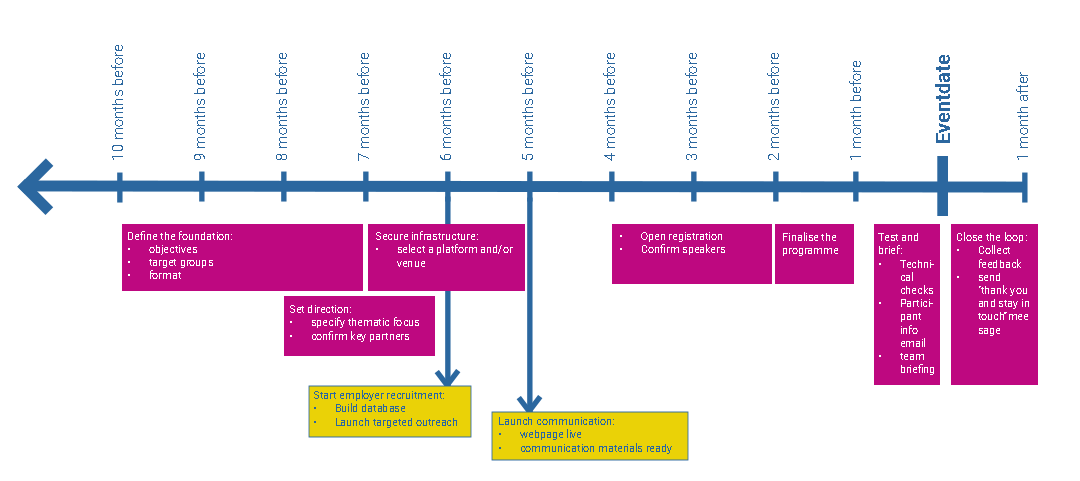
Presentations, company inputs and networking activities form the core content blocks of a matchmaking event agenda. Together, they help you set the scene, provide participants with concrete information about career opportunities, and create space for meaningful interaction between researchers, employers and other stakeholders.
Presentations and panel discussions
- Use a presentation or panel discussion to set the scene for the day and share key insights or practical tips with participants; keep it interactive to stimulate active engagement throughout the event.
- Invite, for example, PhD graduates working outside academia or HR professionals from companies to share their perspectives.
- Plan 45–60 minutes for a panel, depending on the number of panellists.
- Start preparations early: ideally at least two months before the event, define the objective of the session and identify suitable speakers or an appropriate mix of panellists.
Employers’ presentations
- Employers’ presentations help participants gain an overview of available opportunities and act as a stepping stone towards the one-to-one meetings.
- You can organise them in different ways: it might be a block of presentations, or you can organise a small “fair” with presentation tables.
- Ask companies to focus on their activities, with particular emphasis on R&D and innovation, and on the opportunities, they offer to researchers.
- You can either collect expressions of interest to present via the registration form (bearing in mind that the final number of presenting companies will remain uncertain until registration closes) or proactively invite selected companies in your target area or sector.
- In the REBECA Matchmaking Event, company presentations were organised in parallel 1‑hour sessions, each featuring 2–3 companies.
Encouraging networking
When planning your event agenda, it is important to think explicitly about how participants will connect and interact. A well-designed networking segment can help researchers build on insights from earlier sessions, ask follow-up questions in an informal setting, and explore potential collaborations or career opportunities with employers and other stakeholders. Plan networking elements that give researchers space to talk with employers, peers and other stakeholders in a low threshold, approachable way (e.g. coffee breaks with discussion prompts, thematic networking corners, or hosted tables).‑designed networking segment can help researchers build on insights from earlier sessions, ask follow‑up questions in an informal setting, and explore potential collaborations or career opportunities with employers and other stakeholders. Plan networking elements that give researchers space to talk with employers, peers and other stakeholders in a low threshold, approachable way (e.g. coffee breaks with discussion prompts, thematic networking corners, or hosted tables).
- Combine more structured formats (such as moderated roundtables, speed networking or topic-based breakout groups) with informal moments where participants can follow up on conversations or start new ones.
- Clearly communicate the purpose and practical setup of each networking element so that participants know what to expect and feel comfortable engaging.
- Where possible, use simple visual cues and facilitation (e.g. badges indicating interests, conversation starters, light moderation) to help participants identify relevant contacts and initiate discussions.
- If the event is hybrid or online, consider virtual networking options such as breakout rooms, open “lounge” spaces, or chat channels dedicated to specific themes or sectors.
- You might have a possibility to use one of the online platforms specifically designed to support match-making such as B-2-match.
Selecting the right digital platform is essential for hosting a successful online matchmaking event. Several commercial platforms are specifically designed for one-to-one matchmaking - many of which you may already know from conferences you have attended. Examples include B2Match, Marcom, Eventtia, and Brela.
These tools enable participants to connect before, during, and after the event. Most providers offer demo sessions to help you explore features and find the best fit. You can usually purchase a license for a single event. While intuitive, they still require preparation time for setup and event management.
When choosing a platform, consider your expected participant numbers, profiles (e.g., researchers vs. companies), and engagement levels. Licenses often include limits on total participants, admin accounts, video conferencing capacity, and company booths. Check if your institution already has a subscription.
If budget constraints rule out a commercial license, you can still deliver effective networking with institutional tools. Platforms like Zoom, MS Teams, or Webex support breakout rooms for one-to-many sessions—assign one per company so researchers can drop in and ask questions. Always verify license limits upfront, including participant numbers, co-hosting rights, recording options, and storage. One-to-one meetings are harder to coordinate on general platforms. Instead, support direct outreach by sharing a CV database with employers or creating a LinkedIn group for participants.
Selecting an appropriate venue is essential for hosting a successful physical event. The right venue can support plenary sessions, parallel workshops, and one-to-one meetings, ensuring participants have a productive and engaging experience.
Consider the different types of activities you need to accommodate when selecting the event venue:
- Plenary sessions: A main hall or auditorium large enough to host all participants comfortably, with appropriate seating audiovisual equipment.
- Parallel workshops or breakout sessions: Smaller rooms that allow multiple sessions to run simultaneously, ideally flexible to support interactive formats.
- One-to-one meetings or exhibition areas: Quiet corners, dedicated booths, or open spaces where companies and researchers can meet individually or showcase their work.
Choose a venue that is easily reachable by public transport and has adequate parking. Nearby accommodation options can be important if participants need to stay overnight.
Ensure the venue can meet the technical and logistical needs of your event: reliable Wi-Fi, power outlets, AV support, and adaptable furniture for workshops, networking, or exhibitions. Consider catering options for breaks and lunch, as well as spaces for informal networking.
Find the example of onsite events here
When planning a hybrid session, ensure the venue supports both onsite and online participants with reliable Wi-Fi and good audiovisual equipment (e.g. cameras and microphones for capturing plenary discussions). Select online platforms that integrate well with your setup, such as those supporting hybrid breakout rooms or shared digital tools (e.g. Zoom or MS Teams) and test all technical elements in advance to prevent disruptions. Communicate clearly to participants how they can engage regardless of location, maximising reach while ensuring an inclusive experience.
Matchmaking platforms such like B2Match, Eventtia, Brela and Marcom usually support hybrid formats by allowing organisers to designate events as "hybrid" during setup, automatically creating options for both onsite ("on-site hybrid") and remote attendance types. Effective communication is essential for attracting participants and ensuring they understand the purpose and benefits of your event. This step involves defining key messages, selecting the right channels, and preparing the necessary tools.
Effective communication is essential for attracting participants and ensuring they understand the purpose and benefits of your event. This step involves defining key messages, selecting the right channels, and preparing the necessary tools.
Make sure your communication covers:
- Event aims and scope: Explain the purpose of the event and, where possible, how it will be structured.
- Value for participants: Highlight the benefits for each target group, showing why they should take part.
- Practical details: Include registration instructions and any selection process if applicable.
When communicating the value of the event, highlight the benefits for each group: for researchers, the event offers opportunities to explore a variety of career paths, gain insights into employer needs beyond academia, and practice networking and communication skills. For employers, it provides access to a pool of talented researchers, increased visibility within the research community, opportunities to learn about other employers, and the potential to develop new collaborations.
The choice of communication tools and channels should depend on who you want to reach, and you may need to use a different mix for each target group.
Tools and channels for communication
- Event website or landing page: Host all essential information in one place. You can use your institutional website and link to the event page on a matchmaking platform to avoid duplication and simplify updates. Example: EURAXESS portal page and B2Match landing page.
- Direct emails: Send invitations directly to target participants and via partner organisations.
- Downloadable materials: Provide short leaflets or summaries that can be attached to emails or shared online.
- Social media: Use your accounts and encourage partners to share posts. Focus on channels relevant to your target audience, e.g., LinkedIn.
- Other formats: Consider videos, podcasts, or infographics, which are easy to share and can make the event more appealing.
One of the main challenges in organising a matchmaking event is reaching and engaging relevant companies. When approaching companies, it is important to clearly communicate the value of participation, such as access to highly skilled researchers, opportunities for collaboration, or increased visibility within the research and innovation ecosystem. Outreach should be targeted and, where possible, personalised, as this significantly increases response rates.
Clearly explain the purpose and format of the event, the expected time commitment, and what companies will gain from participating. Tailor messages to different types of organisations (e.g. SMEs vs. large companies, R&D-intensive vs. innovation-oriented firms).
You can use existing intermediaries (e.g. TTOs, chambers of commerce, Enterprise Europe Network) to introduce the event, as trusted channels can increase credibility.
Be prepared that you might need to approach dozens of companies. If you do not already have access to company databases, these will need to be built from scratch. This can be time-consuming and will likely require regular updates throughout the preparation phase. However, once established, a well-maintained contact list can be reused for future activities, making the initial effort a worthwhile investment.
Potential sources for identifying and contacting companies include:
Within your institution:
Contact the Technology Transfer Office or other units collaborating with the private sector to explore whether they can provide access to existing industry contacts or help promote the event.
Within national or local ecosystem
- National or regional inventories of organisations engaged in research and development activities.
- Lists of beneficiaries of national funding schemes supporting applied research and innovation.
- Enterprise Europe Network contacts, organisations promoting national or regional R&D, chambers of commerce, and public agencies supporting SMEs. These organisations can often support dissemination through their established communication channels.
At European level:
- The partnering database of the EURAXESS Portal, which includes profiles of hundreds of registered companies, ranging from SMEs to large enterprises.
- Databases of organisations funded under Horizon programmes, which allow filtering by thematic area and other criteria and typically offer downloadable beneficiary lists.
Event delivery
After weeks or even months of preparation, the event day itself is the moment where all planning comes together. Careful coordination, clear communication, and ready-to-respond support are essential to ensure a smooth experience for participants, speakers, and partners. Whether your event takes place onsite, online, or in a hybrid format, anticipating practical needs and having clear procedures in place will help you handle challenges confidently and keep the focus on meaningful interaction. The sections below provide practical tips for managing event delivery across different formats, from final checks and live facilitation to feedback and follow-up activities.
Pre-event preparation and support
- Visit the venue in advance to check room layouts, seating capacity, accessibility, signage, and technical equipment (AV, microphones, screens, Wi-Fi).
- Prepare an information e-mail summarising key details about the event (arrival time, registration desk location, agenda highlights, contact person on site).
- Communicate clearly with presenting companies about what is expected from their presentations (timing, format, technical requirements, and on-site logistics such as poster areas or demo spaces).
- If the event includes structured networking or matchmaking, prepare clear instructions on how it will work onsite (e.g. designated meeting areas, time slots, support staff).
- Brief moderators and team members on their roles and responsibilities. Ask them to arrive at least 30 minutes before the event starts to allow time for final checks and coordination.
During the event
- Start the session by welcoming participants and explaining the basic rules of the event (timing, how and when questions can be asked, transitions between sessions).
- Ensure that support staff are visible and available throughout the event to answer questions, guide participants, and solve any logistical or technical issues.
If networking or one-to-one meetings are part of the programme, be available during these blocks to support participants and keep the schedule running smoothly. For multi-day events, ensure daily check-ins and regular presence of the organising team on site.
Pre-event testing and support
- Since you are going to work with new tools and approaches dedicate some time to testing everything.
- Prepare the information e-mail summarising information about the event. Make sure that all participants involved know the essential information about how the event will be run and how to use the platform.
- Communicate with presenting companies on what is expected from the presentations.
- If you are using matchmaking platform, organise testing calls for speakers and presenting companies. Hold these meetings within the platform so they can try out its features. It is also a good opportunity to remind them that they registered for the event (yes, the experience is – some forget).
- Organise the test calls for moderators and other members of the team involved and brief them on their role. Ask them to connect at least 15 minutes before the event starts to make sure that everything works well.
- Start the session by welcoming participants and explaining the basic rules of the event (rules for using microphones and cameras, explaining when and how the questions can be asked).
- If you are going to record the session(s), do not forget to inform the audience about it.
- In case you use the matchmaking platform, be available for the questions throughout the whole time of a one-to-one meetings block. If those are distributed over several days, you do not need to be available 24 hours but check the event in the platform regularly.
During the event
- Start the session by welcoming participants and explaining the basic rules of the event (rules for using microphones and cameras, explaining when and how the questions can be asked).
- If you are going to record the session(s), do not forget to inform the audience about it.
- In case you use the matchmaking platform, be available for the questions throughout the whole time of a one-to-one meetings block. If those are distributed over several days, you do not need to be available 24 hours but check the event in the platform regularly.
- Since hybrid events combine onsite and online elements, dedicate sufficient time to testing both the technical setup at the venue and the online platform. This includes sound, cameras, streaming quality, screen sharing, and internet stability, as well as the integration between onsite equipment and the online tool.
- Clearly define which parts of the programme are onsite, online, or hybrid, and communicate this to all participants in advance.
- Prepare an information e-mail summarising key details about the event, including venue information, access links, agenda, technical requirements, and contact details for support during the event.
- Communicate clearly with presenting companies and speakers about hybrid-specific expectations. This includes presentation timing, interaction with both audiences, camera and microphone use, and how questions from onsite and online participants will be handled.
- Brief moderators and other team members on their roles, making a clear distinction between onsite moderation and online facilitation (e.g. chat and Q&A monitoring). Ask onsite team members to arrive well in advance and online team members to connect at least 15 minutes before the event starts.
During the event
- Start the session(s) by welcoming both onsite and online participants and explaining the basic rules of the event. This should include how questions can be asked from each audience, when microphones should be used, and how interaction between onsite and online participants will be managed.
- Ensure continuous technical monitoring throughout the event to quickly address sound, video, or connection issues. Assign dedicated support for online participants so that their questions or problems are not overlooked.
- Actively support engagement of both audiences and avoid focusing only on one group. Moderators should regularly acknowledge online participants and alternate between onsite and online questions.
- If networking or one-to-one meetings are part of the programme, provide clear instructions for both onsite and online formats and ensure support is available throughout these sessions to keep the experience smooth and inclusive.
Feedback and follow-up
- Prepare a short and clear feedback questionnaire focusing on key aspects of the event (content, organisation, format, usefulness). Keep it concise to increase response rates.
- Decide in advance when and how feedback will be collected (e.g. immediately after the event, via e-mail, QR code onsite, or through the event platform).
- Send the participant a “thanks for your participation” message. Use it also as an opportunity to remind them of the feedback questionnaire if necessary.
- Invite the participants to follow your social media profiles to stay informed about future events and updates.
Lessons learnt
Plan well in advance. The overall organisation of the event—from the initial concept to Event day—took more than six months in case of the REBECA Online Matchmaking Event for example. Recruiting employers proved to be the most time-consuming phase and should be prioritised early in the planning process.
Invest in tailored communication. Although all participants attend the same event, PhD students and employers have different expectations and derive different benefits. This should be reflected in information materials and invitations. Messages for each target group need to be clear, concise, and purpose-driven.
Offer multiple networking formats. In discipline-specific events, employers may wish to network not only with PhD students but also with other companies or key stakeholders. Make this opportunity explicit and ensure there is dedicated time and space for these interactions.
Manage expectations carefully. For example, in the process of organising the REBECA Online Matchmaking Event, communication with employers revealed that some could not offer immediate job opportunities but were still keen to meet PhD students. This was clearly communicated to both employers and PhD students, encouraging openness to a broad range of potential collaborations rather than focusing solely on recruitment. Manage expectations regarding innovation and public-private collaborations to compnaies, if your event is not targeted to researcher prepared for this type of collaborations, companies can get disappointed.
Get inspired
If you are looking for examples to get inspired, here you can find matchmaking and networking events organized by members of EURAXESS:
- Connecting Research Talents to Business: Matchmaking event for PhD students, companies and other stakeholders. Organized by SAIA
- Careers Beyond Academia-Networking Event. Organized by LBG Career Center – Ludwig Boltzmann Gesellschaft.
- REBECA by EURAXESS Researchers2Businesses fair "Health, Wellbeing, Climate, Environment & Mobility". Organized by Researcher Career Beyond Academia-EURAXESS Hub.
Key recommnedations
Assess your resources first. Carefully evaluate your experience, available time, budget, and network before committing. Organise a standalone event only if you have sufficient capacity.
Plan your timeline strategically. Begin preparations early – at least six months in advance if targeting large companies. Send a “save the date” announcement early, open registration later, and tailor communication to different target groups while managing expectations clearly.
Define objectives and target groups early. Clarify your goals and identify your primary audiences (e.g. researchers, companies) before selecting the format (online, onsite, or hybrid) and the appropriate platform.
Set a clear thematic focus. Define the topic early to shape the agenda and communication strategy. Strike a balance between specificity (to enable high-quality matches) and breadth (to encourage wider participation).
Collaborate with strategic partners. Engage organisations such as Enterprise Europe Network, institutional Technology Transfer Offices, or relevant local institutions to share responsibilities for participant recruitment, platform management, and communication.
Choose the right platform for online or hybrid formats (or to support your onsite event). If you have resources, select a professional matchmaking tool (e.g. B2Match, Brella) that supports participant profiles, 1:1 meetings, agenda management, and feedback collection. Test all features well in advance.
Prepare participants thoroughly. Provide clear instructions, set realistic expectations, and share practical networking tips to maximise engagement and meeting quality.
Test and brief before the event. Conduct technical and venue checks, test the platform, brief moderators, speakers, and participating organisations, and ensure smooth coordination for online, onsite, or hybrid delivery.
Follow up after the event. Collect feedback, thank participants, monitor interactions and outcomes, evaluate whether objectives were met, and keep profiles and contact information accessible to support continued collaboration.
-
If you have some experience, you could decide to organise a subevent within an existing event. You can benefit from the contact database of the organiser, but you have complete control over your subevent.
Before you start with the organisation though, it is useful to take a step back and reflect on a few key questions. Discussing these early on will help you clarify the aim, scope, and overall direction of your subevent. It might also help you decide with whom you want to collaborate.
Designing phase
The first step before joining an event is to think about your goals. What do you want to achieve, who do you want to reach and what do you feel comfortable with organising? And what is possible, budget wise?
If you have determined your goal and target audience, you can decide which event is most suitable. Maybe you are asked to join an event. However, flattering that may be, always keep your goals in mind and think if participation is worth your time and money.
It is possible to create an idea first, and then find a partner with regular events. Or find an event that you can pitch your idea of a subevent to.
It is also possible to find a partner first and then brainstorm together about options to join forces. However, do not forget your objective: to organise a subevent within a larger event. You didn’t want to (co-)organise an entire event.
Choosing a theme and target group is essential for developing a relevant agenda and ensuring effective communication. It also ensures that you reach the goals or target group you want to reach.
If the subevent is focused or broad, depends on your earlier defined goal(s) and target audience. For example, you can align the theme of your subevent to the theme of the main event and open it to all participants. But, if you have a very specific goal or target group in mind, you can define a thematic focus and/or target group.
A more specific focus increases the likelihood that participants will find relevant and meaningful connections. It also makes communication easier and helps manage expectations, as potential participants will have a clear understanding of what the subevent offers. However, a narrower focus can make recruitment more challenging. Attracting a sufficient number of participants and companies may require extra effort.
When you are organising a subevent, it is important to involve the correct partners, to strengthen the event’s reach and impact. Consider involving:
- The organisers of the main event. They can help define the subevent, so it fits into the main event nicely. They can also help with the promotion of the subevent.
- Other units within your institution, such as career development centres and communication colleagues.
- Technical help like an IT team, if you are working with an online platform. They can offer IT support and check audio and video.
Your choice of interaction formats influences several key aspects of the event and should be clearly communicated to participants. It determines how the agenda is structured and affects which technical or organisational tools are needed to support networking. While the primary aim is usually to connect researchers with companies or other non-academic employers, you may also encourage networking:
- among researchers,
- between companies and universities,
- between companies,
- between companies and other stakeholders.
If the goal is to primarily connect researchers with potential employers, you can think of different activities in your programme like companies’ presentations, CV checks, the possibility to upload CV’s or look at CV’s and schedule an interview during the subevent, etc.
The interaction formats, together with the target group, determine the possible form of the subevent: completely onsite, online or hybrid. Of course, that also depends on the form of the mail event. If that is completely online, then your subevent will also be.
Preparation phase
This section highlights the key elements to consider when planning a matchmaking subevent, from defining your programme and selecting an appropriate venue or digital platform, to setting up communication, managing registrations, and engaging relevant companies. The guidance below is designed to help you make informed organisational choices, clarify responsibilities with the main event organisers, and maximise the impact of your subevent for participants and partners alike.
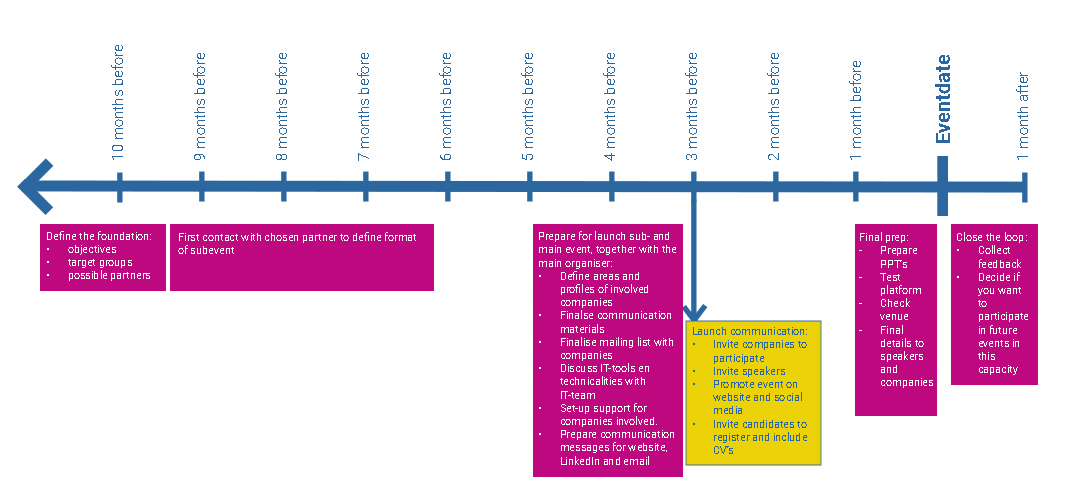
Presentations, company inputs and network activities form the core content blocks of a matchmaking event. Together, they help you set the scene, provide participants with concrete information about career opportunities, and create space for meaningful interaction between researchers, employers and other stakeholders.
For a subevent, it is possible that you will be responsible for only a one or two of those activities. Below we will present some of the options, together with important aspects.
- Thematic presentations: invite experts to talk about important topics like visas and residence permits, family reunion, recognition of diplomas, etc.
- Employers’ presentations: invite companies to share about their companies' activities. These presentations often help participants gain an overview of available opportunities and act as a stepping stone toward one-to-one meetings.
- One-on-one meetings: you can offer the opportunity to participants to engage in one-on-one conversations. These meetings could be pre-arranged or not. They could be between researchers and companies, or between researchers and advisors or between companies and institutions, etc.
- Professional photography: you could offer the option of having a professional photograph taken.
These are just some suggestions, of course there are more options.
When organising a subevent within a main event, it is very important to check details about the venue or, in case of an online or hybrid event, the digital platform used. Make sure that you know what kind of space of platform is available to you and if you should make any additional arrangements.
For example: if you organise an online subevent during an onsite event, you might need to arrange the digital platform yourself. Or if the main- and subevent is online, it is possible that the platform provided by the main organisers does not support all activities you want to provide during your subevent.
When you need to make arrangements for a platform yourself, consider your expected participant numbers, profiles (e.g., researchers vs. companies), and engagement levels. Licenses often include limits on total participants, admin accounts, video conferencing capacity, and company booths. Check if your institution already has a subscription.
If budget constraints rule out a commercial license, you can still deliver effective networking with institutional tools. Platforms like Zoom, MS Teams, or Webex support breakout rooms for one-to-many sessions—assign one per company so researchers can drop in and ask questions. Always verify license limits upfront, including participant numbers, co-hosting rights, recording options, and storage. One-on-one meetings are harder to coordinate on general platforms. Instead, support direct outreach by sharing a CV database with employers or creating a LinkedIn group for participants.
When you are organising a subevent, you probably want to create some information on your own website about it. This can be in the form of a newsarticle, a dedicated webpage or even a seperate website. However, it is good to check a few things:
- Will your subevent also be included on the website of the main event? Make clear agreements about communication. Is it expected of you to arrange a webpage, or do you need to send information for their website. If you are responsible for a page, make sure to at least have a link to that page on the website of the main event.
- Event registration: do participants register for your subevent via the main event website or do you need to arrange for a registration tool? Also make clear agreements about this part.
Effective communication is essential for attracting participants and ensuring they understand the purpose and benefits of your subevent. Lucky for you, you can piggyback on the communication surrounding the main event. Make sure that directly after partnering up, you share your logo en website link, to be mentioned in all communication about the main event.
Additionally, you should put in some effort as well. Make sure your communication covers:
- Aim and scope of the subevent: explain the purpose and, where possible, how it will be structured
- Value for participant: highlight the benefits for each target group, showing why they should take part.
- Practical details: including registration instructions and any selection process if applicable.
The choice of communication tools and channels should depend on who you want to reach, and you may need to use a different mix for each target group.
Tools and channels for communication
- Event website or landing page: Depending on the communication agreements with the host, you will use their website or your own to gather all information about your subevent.
- Direct emails: Send invitations directly to target participants and via partner organisations. Also, create a banner that you can add to your email signature. That way, every email you send is promotion for the subevent you are organising.
- Newsletter: If you have a newsletter, make sure to include the subevent in the calendar or as a news article.
- Downloadable materials: Provide short leaflets or summaries that can be attached to emails or shared online. This is also handy for the main organiser, to promote your subevent.
- Social media: Use your accounts and encourage partners (like the main organiser) to share posts. Focus on channels relevant to your target audience, e.g., LinkedIn.
Other formats: Consider videos, podcasts, or infographics, which are easy to share and can make the subevent more appealing
One of the main challenges in organising a matchmaking subevent is reaching and engaging relevant companies. When approaching companies, it is important to clearly communicate the value of participation, such as access to highly skilled researchers, opportunities for collaboration, or increased visibility within the research and innovation ecosystem. Outreach should be targeted and, where possible, personalised, as this significantly increases response rates.
Clearly explain the purpose and format of the subevent, the expected time commitment, and what companies will gain from participating. Tailor messages to different types of organisations (e.g. SMEs vs. large companies, R&D-intensive vs. innovation-oriented firms).
You can use existing intermediaries (e.g. TTOs, chambers of commerce, Enterprise Europe Network) to introduce the event, as trusted channels can increase credibility. Of course, you can also make use of the contacts of the organiser of the main event. Make clear communication agreements in your partnering contract.
Be prepared that you might need to approach dozens of companies. If you do not already have access to company databases, these will need to be built from scratch. This can be time-consuming and will likely require regular updates throughout the preparation phase. However, once established, a well-maintained contact list can be reused for future activities, making the initial effort a worthwhile investment.
Potential sources for identifying and contacting companies include:
Within your institution:
Contact the Technology Transfer Office or other units collaborating with the private sector to explore whether they can provide access to existing industry contacts or help promote the subevent.
Within national or local ecosystem
- National or regional inventories of organisations engaged in research and development activities.
- Lists of beneficiaries of national funding schemes supporting applied research and innovation.
- Enterprise Europe Network contacts, organisations promoting national or regional R&D, chambers of commerce, and public agencies supporting SMEs. These organisations can often support dissemination through their established communication channels.
At European level:
- The partnering database of the EURAXESS Portal, which includes profiles of hundreds of registered companies, ranging from SMEs to large enterprises.
- Databases of organisations funded under Horizon programmes, which allow filtering by thematic area and other criteria and typically offer downloadable beneficiary lists.
Delivering the event
After months of preparation comes the ‘Event Day’. The following section summarises a few tips how to make sure that everything runs smoothly
When you join an existing event, you will probably not be part of the ‘event team’. However, make sure to include colleagues who have any role in the event. It could be a speaker, or a colleague at the office who will take care of social media. Make sure that everyone is aware of their tasks on the day itself. What time to arrive at the (online) location, or what time to expect content to post on social media, etc. How do you make sure everyone is prepared? Either send an e-mail or schedule a short meeting to discuss the event.
When you make use of an online platform or online tools, make sure to test that everything works as it should. It can involve small things, like is a QR-code referring to the correct link? But it can also be something big, like is a digital platform working, are digital stands ready and decorated and do all speakers know how the platform works. Make sure everyone involved on your side (colleagues, speakers, IT-support) has tested before the event, so any possible hiccups will be kept to a minimum on the event day(s).
If you are going to an onsite event, you need to think of the following.
- How much (communication) items will you take with you to the event?
- Can you carry the items with you on the day itself? (think of signage, technical equipment, roll-up banner(s), flyers, etc.). Or do you need to arrange for transport?
- Make sure to check transport arrangements with the organisers of the main event and schedule this at the latest two weeks in advance, so you will make sure the transport company has time to deliver your goods to the venue.
- To make sure you will not leave anything behind at the office, please use a checklist.
- Once arrived, make sure to check the venue for signage, room layouts, signage, technical equipment (AV, microphones, screens, Wi-Fi), etc.
When the event is over, you off course want to know if you achieved your goals.
- Schedule an internal review after the event, with all colleagues involved. Discuss if the effort was worth the outcomes.
- Schedule a review with the host of the main event.
- Discuss with the organisers of the main event if they will send out an evaluation to all delegates. If you want to know something specific, maybe you can add a question to their evaluation and receive the answers.
Lessons learned
Timing could be a key issue. For the European Job Days Portugal it was a real challenge, particularly in what regards promotion.
Matchmaking: Presentations from companies and other potential employers are key to attract the most suitable employees to fit the job, both from the point of view of companies and candidates.
It is very difficult to evaluate the impact of the event, even when requesting both companies and candidates to fill in a survey about their experience of participation.
- Organising a subevent within another event can be an excellent experience. The advantages for you as a company:
- Benefit from the experience of the main organiser.
- Benefit from the technical infrastructure and technical support from the main organiser.
- Benefit from the participation in a huge event, with no budgetary commitments.
- Benefit from the contacts of the main organiser: a pool of companies in different regions in the country.
- Be able to promote your own companies' and EURAXESS’ programmes and initiatives during the event.
With your subevent, you also bring added value to the main event:
- Improve the visibility of the main organiser within a new public.
- Increase attractiveness of the main event with the subevent and for example the highly innovative companies that are invited by for that part of the programme.
- Increase their contacts with your own.
- Your own expertise.
Get Inspired
If you are looking for examples to get inspired, here you can find matchmaking and networking events co-organized by members of EURAXESS:
- European Job Days Portugal. Organised by FCT.
Key recommendations
First determine your goal(s) and target audience, and then decide which partner or event is most suitable for the organisation of a subevent. If you get invited to join an event, ask yourself IF the event is suitable.
Establish a timeline with the main organiser and make sure there is a clear understanding of deadlines, responsibilities and communication collaborations. There are actions you can take care of right after signing a contract. Other actions need to be carefully planned.
Define a focus for your subevent. Make it as broad or specific as necessary to reach your goals and target group.
Test. Conduct technical and venue checks and/or test the online platform or other digital tools you or participants will use.
Make sure all colleagues, speakers and organisations involved know what to do/expect.
Please doublecheck the freight for an onsite event, whether you bring it with you yourself or arrange for transportation. Items are easily overlooked, so use a checklist.
Make sure you schedule time for evaluation. Not only do you want to know what the participants thought of your role within the event. You also need to evaluate if your goals have been reached and if your participation was worth the effort and budget.
-
If your experience is minimal, or your resources (time, budget and contacts) are minimal, it might be good to join an existing event. You can benefit from the contact database of the organiser, and it takes a lot less effort to show up, man a stand and maybe present a workshop or session.
But still, you need to think about the basics. So please look at the toolkit for joining an existing event.
Designing phase
The first step before joining an event is to think about your goals. What do you want to achieve, who do you want to reach and what can you do, budget wise?
If you have determined your goal and target audience, you can decide which event is most suitable. Maybe you are asked to join an event. However, flattering that may be, always keep your goals in mind and think if attending is worth your time and money.
It is good to know that events are not always onsite anymore. It is also possible to join an event online. If your goal is to reach a lot of researchers from other countries, online participation could offer a wonderful solution.
When you do decide on the existing event, think about your level of participation. This also connects to the earlier set goals. Do you want visibility? Do you have a specific message you want to share? Decide which type of participation suits best. It could be just a stand, or a sponsorship with logo visibility. You could also decide to give an additional workshop or presentation. It is up to you. Consider the costs and the possible outcomes and then decide. If you are not sure, feel free to ask the organisers about their experience with the different participation options.
Preparation phase
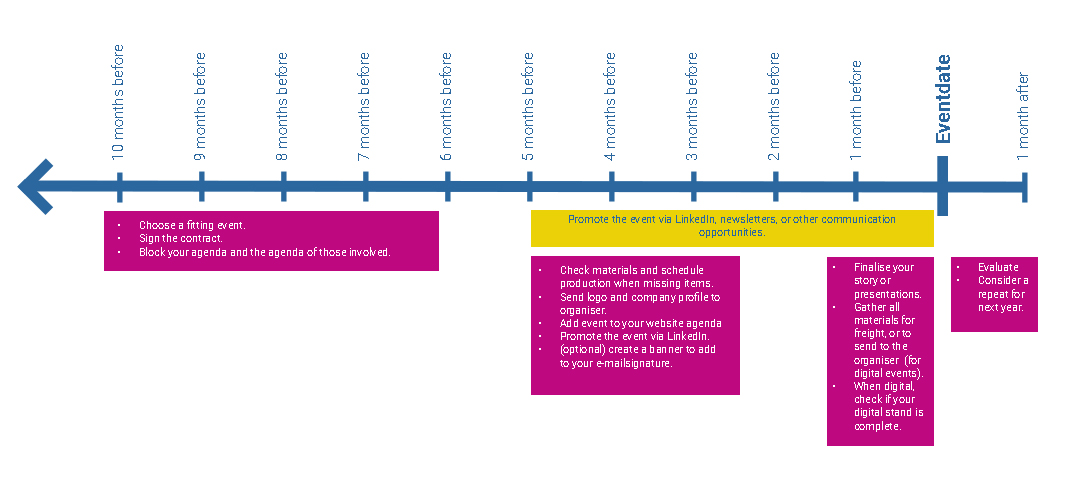
If you are part of the regular programme (with sessions and workshops), you need to think about the content of your session or presentation. Will you present yourself or will you arrange for speakers? Make sure to block agenda’s well in advance, preferably 4 months prior to the event. Depending on the timeline or the organiser, create a short summary of your session, so delegates will know what to expect. And make sure to create the presentation at the latest two weeks prior to the event. That way you can share the slides well in advance with the organiser and you don’t have last minute stress because of last minute preparations
For your visibility, make sure to arrange for a company profile and logo directly after signing a contract for your participation with the organiser.
Also think about promotional items for your (digital) stand. Do you have branded give aways? Do you have a (digital) flyer or a video or do you need to create something? If you need to create something new, please keep production time in mind. And aim for delivery of goods, three weeks before the event. That way you still have time to check and arrange for transport to the event location. Or time to share it with the organisers to upload to a virtual environment.
For the promotion, make sure to include the event to your website and schedule several LinkedIn posts on your channel. This could be a ‘save the date’, early-bird registration, late registration and post on the day of the event. If you have a newsletter, you could also include the event in there, as an agenda item for example.During an event, there are plenty of tools you can use to stand out or interact with delegates. To make a session more interactive, think about audience engagement tools. Examples include Mentimeter, Slido or Kahoot. If you want to stand out, you might want to show a video at your (online) stand. Most of the time, when part of the event is online, the organiser will provide the digital platform or tools, but make sure it has everything you need. If your stand is onsite and you want to show video, you will need a screen. Most of the times, it is not part of the standard packages. If you are looking for a sustainable way to ‘hand-out’ flyers or business cards to delegates, you could use QR-codes or NFC-codes.
What is important with the use of tools, is testing. Whatever you use: if it’s a platform, an audience engagement tool or a QR-code, make sure to test if it works.The event
When participating in an event as part of your organisation, even if you are not leading its organisation, good preparation and coordination are key to ensuring a successful presence. From clearly defining the roles of everyone involved, to planning how materials are transported and used on-site, and finally evaluating the outcomes after the event, these elements help ensure that your participation is both efficient and impactful.
When you join an existing event, you will probably not be part of the ‘event team’. However, make sure to include colleagues who have any role in the event. It could be a speaker, or a colleague at the office who will take care of social media. Make sure that everyone is aware of their tasks on the day itself. What time to arrive at the (online) location, or what time to expect content to post on social media, etc. How do you make sure everyone is prepared? Either send an e-mail or schedule a short meeting to discuss the event.
If you are going to an onsite event, you need to think of the following.
- How much promotional items will you take with you to the event?
- Can you carry the items with you on the day itself? (think of a roll-up banner, flyers and give aways). Or do you need to arrange for transport? (if you have a bigger stand design for example with your own stand wall).
- Make sure to check transport arrangements with the organisers and schedule this at the latest two weeks in advance, so you will make sure the transport company has time to deliver your goods to the venue.
- To make sure you will not leave anything behind at the office, please use a checklist.
When the event is over, you off course want to know if you achieved your goals.
- Schedule an internal review after the event, with all colleagues involved. Discuss if the effort was worth the outcomes.
- Discuss with the organisers ahead of the event if they will send out an evaluation to all delegates. If you want to know something specific, maybe you can add a question to their evaluation and receive the answers.
Lessons learned
- Be honest about your goals and available resources when discussing your participation in an existing event. Organisers can help you decide what level of involvement matches your goals and maybe they offer discount prices when they know your budget.
- Be honest to yourself when deciding on your level of participation. Do you really need a gold level sponsorship, or could you make do with a bronze level sponsorship and save money for maybe another activity or something else?
- Sometimes you just need to test if a participation is worth your investment. In that case, choose a low-level involvement that still matches your goals and learn from the experience.
Get inspired
If you are looking for examples to get inspired, here you can find matchmaking and networking events participated by members of EURAXESS
- BCF Career Event (onsite). Organised by BCF and participated by NUFFIC
- The Netherlands Recruitment Day (online). Organized by Academic Transfer and participated by NUFFIC
Key recommendations
First determine your goal(s) and target audience, and then decide which event is most suitable. If you get invited to join, ask yourself IF the event is suitable. Also, keep your goals in mind when deciding about your level of participation.
Establish a timeline with the organiser and make sure there is a clear understanding of deadlines. There are actions you can take care of right after signing a contract. Other actions need to be carefully planned.
Check your supply. What do you need for the event? Do you have enough promotional items or do you need to create something? Keep in mind the deadlines you have established with the organiser and plan accordingly.
Are you using tools? Make sure to test them properly before the event.
Make sure all colleagues involved know what to do. Whether they are a speaker, manning the stand or posting about the event on social media.
Please doublecheck the freight for an onsite event, whether you bring it with you yourself or arrange for transportation. Items are easily overlooked, so use a checklist.
Make sure you schedule time for evaluation. Not only do you want to know what the participants thought of your role within the event. You also need to evaluate if your goals have been reached and if your participation was worth the effort and budget.